mon afriqueil y a 3 mois
Modibo Soumaré
Équipe SenDiaspora
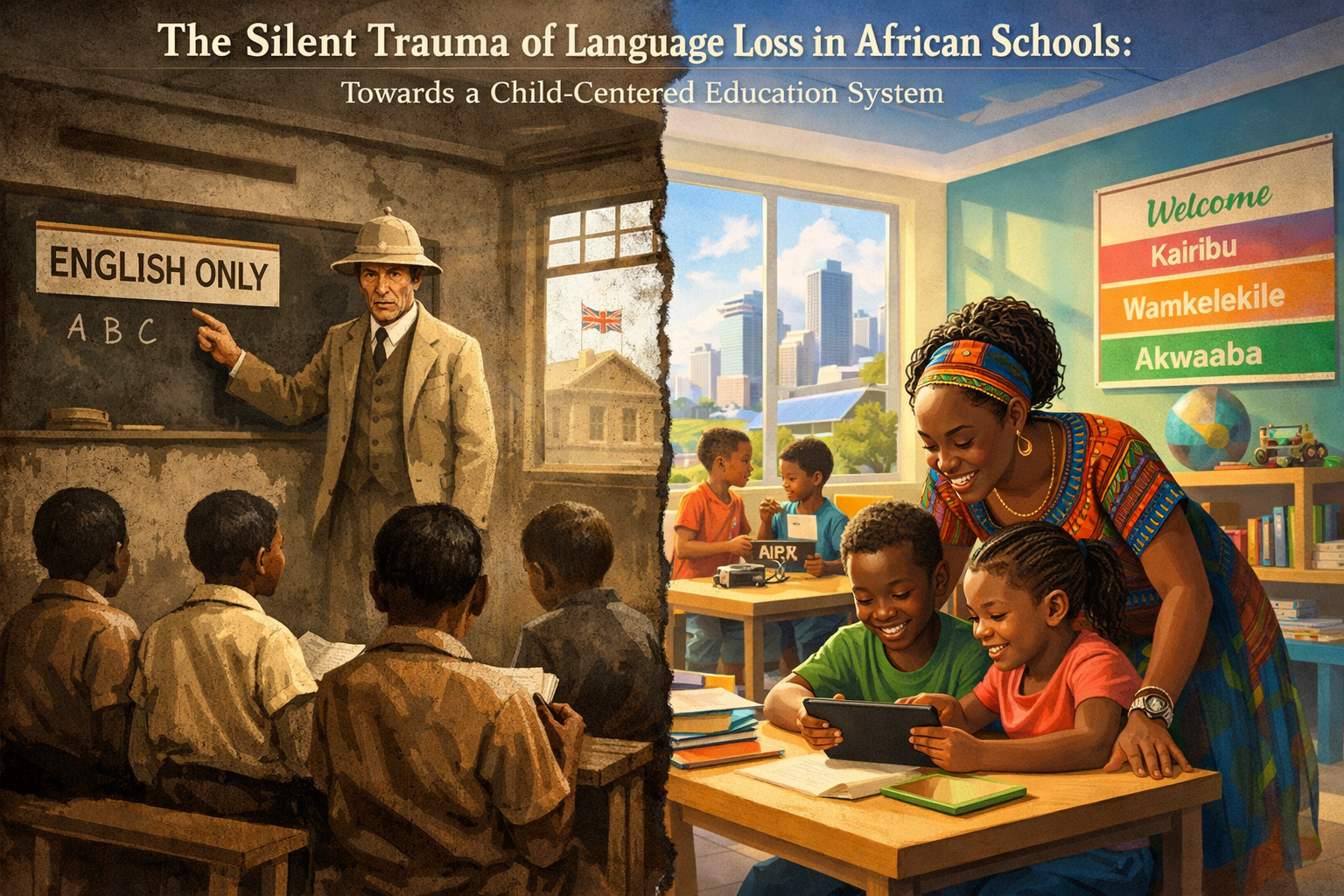
As we enter the third decade of the 21st century, African children are enrolling into national school environments where their mother tongues are excluded and replaced by colonial languages such as English, French, Spanish, German, Arabic or Portuguese. Is this tradition, rooted in the civilizing mission of French stateman Jules Ferry, implicitly framing Western and Eastern languages as superior? Or, are Africans benefiting from this tradition to enrich their mother tongues?
Cheikh Anta Diop argued that language is the “DNA of culture,” and therefore stripping children of their linguistic heritage severs them from their identity and worldview. The psychological impact is profound: confusion, alienation, and diminished self-worth. The renowned anthropologist motivates our efforts to develop methods and systems for cultural authenticity, fostering the creation of dictionaries and corpuses to promote, maintain and develop African languages thereby preventing their extinction or the rise of new generations of cultural orphans struggling to move-up the slippery slope of assimilation. He believed that peoples who have been culturally marginalized, like those across Africa and its diaspora, must first reclaim their historical languages to contribute meaningfully to the universal human project.
The poet-president Leopold Sedar Senghor was also an early proponent of cultural globalization, which has still not to come pass, instead economic globalization has become a reality thanks to advancements in cultural assimilation, media and entertainment, financial digitalization and improvements in transportation. The notion of “comparative advantage of nations” now defines the new-world-order in which we are leaving-in. As an early globalization proponent in the 1960’s, the poet-president wrote about: “Enracinement et Ouverture”. He argued for “Eurocentric Assimilation” and proposed a form of “cultural métissage” or harmonious dialogue of all civilizations on equal terms. However, isn't it utopic to believe that African and Western languages can equally enrich one another to build a universal human civilization?
The evidence outlined in the rest of this reflection is telling and provides a clear “Reason for Being” for the SENDIASPORA.COM dictionary:
Psychological Impact of Language Loss:
Identity Conflict: Children are told their home language is “unsuitable” for learning, creating inferiority complexes.
Cognitive Barriers: They must first master a foreign language before accessing knowledge, slowing comprehension.
Alienation from Elders: Language shift prevents intergenerational communication, weakening cultural transmission.
Why Western-Language Schooling is Detrimental:
High failure rates: 89% of Sub-Saharan African children cannot read with comprehension by age 10 when taught in colonial languages (World Bank, 2019).
Psychological scars: Children internalize the idea that progress requires abandoning their culture.
Cultural erosion: Generational gaps widen as children lose the ability to communicate with elders in their native tongue.
An Alternative Education System:
Mother-Tongue Foundation: Early education in local languages to build literacy and confidence.
Gradual Introduction of Global Languages: English/French taught as secondary tools for international communication.
Community Integration: Elders and local scholars contribute oral traditions, proverbs, and cultural knowledge.
Hybrid Pedagogy: Combining indigenous linguistic structures with modern curricula, as Kay Williamson advocated.
Conclusion
Western-language schooling in Africa is not neutral—it is a form of cultural violence. It leaves children psychologically scarred and academically disadvantaged. As Diop insisted, reclaiming African languages is essential for reclaiming African dignity.
📚 Bibliography
Bamgbose, A. (1991). Language and the Nation: The Language Question in Sub-Saharan Africa. Edinburgh University Press.
Batibo, H. M. (2005). Language Decline and Death in Africa: Causes, Consequences and Challenges. Multilingual Matters.
Diop, C. A. (1974). The African Origin of Civilization: Myth or Reality. Lawrence Hill Books.
Williamson, K. (1982). Linguistic Evidence for the Prehistory of the Niger Delta. University of Port Harcourt.
Delafosse, M. (1912). Vocabulaires comparatifs de plus de 60 langues ou dialectes. Paris: Leroux.
UNESCO (2021). The State of Education in Africa. Paris: UNESCO.
World Bank (2019). Ending Learning Poverty: What Will It Take?. Washington, DC: World Bank.